Twenty Riders, One Valley… and a Very Questionable Relationship With Comfort
Cold Desert Conquest 2026 captures an unforgettable Harley ride through the majestic and unforgiving landscapes of Spiti Valley. From brutal heatwaves and broken mountain roads to the silence of high-altitude borders, this journey became more than an adventure — it became a test of endurance, discipline, brotherhood, and perspective forged in the heart of the Himalayas.Blog post description.
RESPECTHUMANITYRIDING FOR SUCCESS
Aaseem A Kulkarni
5/23/20269 min read
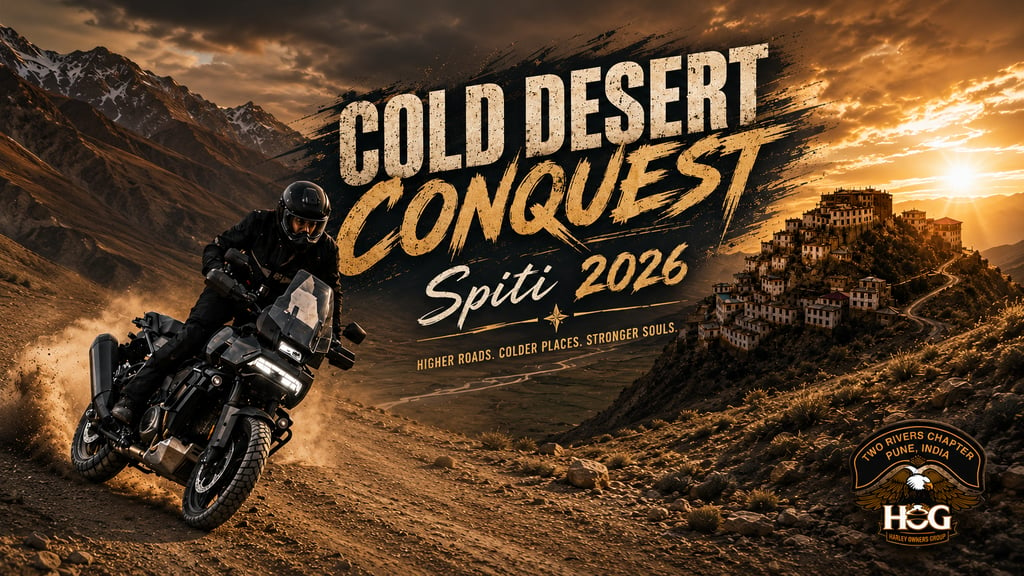
Everyone who knows me even remotely well knows one thing — I have a dangerous weakness for mountains. Especially the Ladakh-Spiti belt. Some people collect watches, some collect wines, and some unfortunately collect emotional baggage. I collect high-altitude suffering on motorcycles.
After the unforgettable Leh ride in May 2025 with Aryan during his 18th birthday, the mountains had quietly occupied permanent real estate in my head. So when Harley Davidson Two Rivers Chapter announced the Cold Desert Conquest 2026 ride to Spiti Valley, there was never really a question of “if.” It was only a matter of “when do we leave?”
The ride was organised by Rock and Roll Riders Pvt Ltd, a professional motorcycle touring company specialising in adventure expeditions. The plan looked beautiful on paper — a seven-day circuit from Dehradun to Dehradun covering Narkanda, Sangla, Chitkul, Tabo, Dhankar, Kaza, Hikkim, Komic, Langza, Kalpa, Kufri and back.
On paper, everything in life looks manageable.
Even marriage.
Then reality begins.
The Real Ride Started From Pune
About 22 riders registered for the ride. Eventually 19 actually made it to the saddle. Which honestly is impressive considering the ride started in the middle of one of the harshest Indian summers in recent memory.
Riders had options:
transport the motorcycles to Dehradun,
ride one way,
or ride both ways.
Naturally, common sense was available in limited quantities.
Some riders transported their motorcycles both ways. Some rode to Dehradun and shipped back later. A few of us, including me, decided to ride Pune to Pune entirely.
Because apparently dehydration and exhaustion are hobbies now.
The dates were locked:
Start: 8th May
Return: 22nd May
Our biggest concern was not the mountains.
It was Madhya Pradesh.
And Agra.
And the giant invisible microwave oven called North Indian summer.
Temperatures in Pune were already touching 42°C. We knew central India would be worse. Much worse. So the strategy was simple:
start ridiculously early,
finish before the sun decided to murder us.
All rides would begin around 4 AM and end by 2 PM.
Having done multiple long-distance rides over the years, I noticed something interesting. The excitement before such rides changes with age and experience.
Earlier, preparation meant enthusiasm.
Now preparation meant:
electrolytes,
medicines,
sleep schedules,
hydration plans,
sunscreen,
thermal layering,
oxygen awareness,
and checking whether your body warranty was still valid.
Pune to Dehradun — The Warm-Up Nobody Asked For
On the morning of 8th May, around ten of us rolled out from Pune at 4 AM.
The target:
Day 1: Dewas
Day 2: Agra
Day 3: Dehradun
Surprisingly, the ride went exactly as planned. No drama. No breakdowns. No major incidents. Everyone reached Dehradun safely.
Frankly, this itself felt suspicious.
The motorcycles transported separately had also arrived safely.
11th May was our designated rest day. While most people rested, I used the opportunity to wash my riding gear because I knew very well what was coming next. Laundry service in Spiti is a fantasy. Express laundry in Spiti is probably a mythological concept discussed alongside unicorns and affordable Harleys.
By evening, all riders had assembled.
Twenty riders representing Two Rivers Chapter stood ready.
The Cold Desert Conquest had officially begun.
Into The Mountains
On the morning of 12th May, we rolled out toward Narkanda.
The moment we escaped Dehradun traffic and began climbing into the mountains, everything changed.
After three days of high-speed highway riding, the Himalayas politely reminded us:
“This is our territory now. Relax your ego.”
Suddenly speed became irrelevant.
The roads twisted endlessly through valleys and cliffs like giant snakes carved into mountainsides by some ancient force of nature. Every turn opened into landscapes so dramatic they almost looked fictional.
Narkanda, famous for its apple orchards and beautiful weather, felt like a gateway into another world. Around Mashobra lies the Rashtrapati Niwas, the President’s summer retreat. Honestly, after seeing the weather there, I completely understood why Presidents migrate there during summer. Even the country’s highest office eventually surrenders before North Indian heat.
The Gate To Spiti — And The Gate To Instagram
On the way toward Sangla we reached the famous “Gate to Spiti,” a naturally formed rock structure made legendary by Instagram reels.
The place was crowded with tourists, cameras, drones, and enough content creators to accidentally start a small production house.
Naturally, our group of nineteen roaring Harleys entering the frame improved everyone’s content quality instantly.
Photos were clicked.
Videos were shot.
Reels were made.
Tourists gathered around the motorcycles as if Marvel superheroes had arrived.
This actually became a recurring theme throughout the valley.
People:
wanted pictures with the bikes,
requested short rides,
filmed us overtaking them,
shot videos from moving cars,
and stared at the convoy with childlike excitement.
To be fair, nineteen Harleys echoing through Himalayan valleys do create a certain atmosphere. Somewhere between cinematic and mildly illegal.
Karcham, Sangla and Chitkul — Where Mountains Begin To Dominate You
As we crossed the mighty Karcham Valley, the terrain became increasingly dramatic.
Karcham sits at the confluence of the Baspa and Sutlej rivers, acting as the gateway into Sangla Valley. The mountains here are not beautiful in the conventional tourist sense.
They are intimidating.
Massive rock faces rise vertically like ancient fortresses. Rivers roar violently through narrow gorges as if permanently angry with gravity. Roads cling to cliffs with questionable confidence.
Then came Chitkul.
The last inhabited village near the Indo-Tibet border.
The final civilian outpost before geography starts becoming emotional.
There is something surreal about standing in places like Chitkul. You suddenly realise how insignificant cities, deadlines, meetings, and social media arguments really are.
Nature does not care.
The mountains simply exist.
Magnificent.
Silent.
Eternal.
Chicham Bridge — Engineering With A Hint of Madness
One place I was especially excited about was Chicham Bridge.
And it did not disappoint.
Suspended at over 13,500 feet above sea level, connecting Chicham and Kibber villages across a terrifying gorge nearly 1000 feet deep, the bridge feels less like infrastructure and more like a challenge issued to gravity itself.
Standing there, staring into the abyss below, I realised two things:
Indian engineers deserve more appreciation.
Human beings are fundamentally overconfident creatures.
On the way we crossed Kibber village, famous for its wildlife sanctuary and snow leopard population. Somewhere in those mountains, hidden among the rocks, snow leopards quietly watched us noisy humans invading their peace on oversized American motorcycles.
Probably judging us too.
Fair enough.
Lepcha La — Where Roads End And Borders Begin
One of the most special moments of the ride came unexpectedly.
On our way back from Kaza, we somehow managed to secure ITBP permissions to visit Lepcha La, one of the forward border posts near the Indo-Tibetan frontier.
The ride there itself felt surreal.
The roads became lonelier.
The silence became heavier.
Civilisation slowly disappeared behind us.
And suddenly we found ourselves standing at the edge of the nation, staring toward Tibetan villages and the ancient Indo-Tibet trade routes that once connected these mountains long before modern borders existed.
Now those routes stand closed.
Silent.
Frozen in history.
There was something deeply emotional about standing there. Wind howled across the barren terrain while mountains stretched endlessly into Tibet beyond the border fences.
Some places are not tourist destinations.
They are reminders of where a nation quietly breathes.
For me personally, this moment felt special because it marked yet another Indian frontier I had now touched after Tanot, Attari and the Rann of Kutch.
Borders have always fascinated me.
Not because of politics.
But because they represent the final edges of human settlement before nature takes complete control again.
Standing there at Lepcha La, surrounded by silence, soldiers and mountains, I felt both incredibly small and incredibly proud at the same time.
Hikkim, Komic and Roads That Officially Resigned From Duty
The roads toward Hikkim were… optimistic suggestions.
Calling them roads felt legally inaccurate.
This stretch truly tested both:
rider skill,
and motorcycle durability.
At times the motorcycles bounced, slid, rattled and protested like union workers nearing retirement.
But the landscapes…
Good lord.
The mountains of Spiti are unlike Leh.
Leh feels raw and harsh.
Spiti feels vast.
Open.
Ancient.
The valleys stretch endlessly under giant skies while snow-covered peaks stand silently in the distance like frozen gods guarding the terrain.
Wind shapes these mountains constantly. Ice, snow, water and air have spent millions of years sculpting this cold desert into something both violent and beautiful.
At Hikkim, home to the world’s highest post office, I took time to send postcards to loved ones.
There was something deeply satisfying about it.
In an age of instant messages and disappearing stories, writing postcards from one of the world’s highest inhabited regions felt wonderfully old-fashioned.
Then came Komic — among the highest motorable villages in the world.
At those altitudes even walking briskly starts feeling like cardio punishment approved personally by the Himalayas.
Kaza — Where The Mountains Quietly Humble You
Our stay at Kaza became one of the most eye-opening experiences of the ride.
The hotel had almost no electricity.
A tiny generator supplied limited power.
Hot water for showers was barely available.
Some riders went two days without bathing entirely.
Now imagine this exact scenario happening in any urban city hotel.
There would probably be:
outrage,
social media warfare,
angry Google reviews,
threats of legal action,
resident WhatsApp groups declaring civil unrest,
and somebody definitely demanding compensation for “mental trauma.”
But in Kaza…
Nobody complained.
Nobody argued.
Nobody’s ego surfaced.
Somehow the mountains quietly reset all of us.
It felt as if the terrain itself was teaching humility.
At those altitudes, survival becomes the primary objective. Comfort becomes secondary. Suddenly things we call “major problems” in daily urban life start appearing laughably trivial.
No WiFi?
So what.
No hot water?
Manage.
Limited electricity?
Sleep early.
The mountains have a beautiful way of stripping human beings down to essentials.
You realise how pampered modern life has made us.
And strangely enough, you also realise how little we actually need to remain happy.
Lessons From The Sutlej
Throughout the journey, the Sutlej River remained our companion.
Sometimes wild.
Sometimes calm.
Sometimes raging violently through narrow valleys.
Sometimes flowing peacefully beside ancient villages.
Watching the river repeatedly carve its way through impossible terrain left me thinking about life itself.
Water does eventually find its path.
No matter what stands in its way.
Maybe that is how life should be lived too.
Not through panic.
Not through force.
But through persistence.
Kalpa — Warmth In The Middle Of Wilderness
Kalpa was technically a transit halt.
Emotionally, it became much more.
Our homestay was run by a humble local family whose hospitality felt genuine in a way luxury hotels rarely achieve. The food was exceptional. The warmth was real. Every small effort carried sincerity.
From the rooftop we could see Kinnaur Kailash standing majestically in the distance, sacred and mysterious beneath changing skies.
After days of dust, cold winds, altitude and rough terrain, Kalpa felt comforting.
Like the mountains briefly allowing us to rest.
Fatigue Finally Arrives
By the time we reached Kufri, exhaustion had begun appearing on faces beneath helmets.
The masks of enthusiasm were slowly replaced by the unmistakable expressions of accumulated fatigue.
Many riders decided to transport their motorcycles back from there.
A sensible decision.
I, however, have historically maintained a complicated relationship with sensible decisions.
I decided to ride back to Pune.
Solo.
For me, riding has always been a sport. And every long-distance ride is a test match between man, machine and mind.
I do not quit easily.
Unless either:
I retire hurt,
or the motorcycle does.
Fortunately neither happened.
And honestly, I credit much of this endurance to the lifestyle changes I have made recently.
During the entire ride:
I maintained sleep discipline,
averaged nearly seven hours of rest,
slept as early as 8 PM when required,
maintained breathing discipline,
and continued meditation regularly.
People often laugh when you prioritise routine and discipline.
Especially in social environments where exhaustion is worn like a medal.
But somewhere along this journey I stopped caring.
This is my life.
I will live it my way.
And the results spoke for themselves.
While many riders battled fatigue, irritability and exhaustion, my breathing remained stable, mood remained positive, and recovery stayed consistent.
The mountains have an interesting way of exposing whether your habits are actually helping you or merely sounding impressive on motivational Instagram posts.
The Furnace Ride Back Home
The return ride through Haryana and Rajasthan was brutal.
Absolutely brutal.
Temperatures touched 47°C.
At highway speeds above 130 kmph, the heat no longer felt like weather.
It felt physical.
Like opening an industrial furnace directly into your face.
By now I had already been riding 6–8 hours daily for over a week. My body had absorbed significant punishment:
heat,
cold,
altitude,
dehydration,
rough terrain,
physical fatigue,
and mental exhaustion.
Every remaining ounce of endurance had to be extracted manually.
Then something strange happened during the final 140 kilometres.
A sudden transformation.
The thought of home triggered a surge of energy I genuinely cannot explain.
Thoughts of:
my wife,
my son,
my dog daughter,
my own bed,
familiar walls,
and home itself
acted like fuel injection directly into the soul.
Fatigue vanished temporarily.
Confidence returned.
Speeds climbed.
And before I fully realised it…
I was home.
Battered But Not Broken
Tired.
Burnt.
Dust-covered.
Sore.
But deeply happy.
This ride tested me at every level:
physically,
mentally,
emotionally,
physiologically.
And somewhere through the heat, dust, snow, altitude and exhaustion, I quietly realised something important.
The new version of me held up well.
Very well.
The mountains tested me honestly.
And I returned with gratitude.
Gratitude
I must thank everyone who made this incredible ride possible.
Special thanks to the managing committee of Two Rivers HOG:
Mr. Kiran Ganjale (Director),
Mr. Vivek Mathur (Assistant Director),
and Kunal Kashyap (Treasurer)
for their efforts in bringing this ride together.
A huge thank you also to the entire team at Rock and Roll Riders Pvt Ltd for executing the expedition professionally while ensuring rider and motorcycle safety throughout.
And finally, to the mountains themselves…
Thank you for once again reminding me:
how small we are,
how strong we can become,
and why some roads are not meant to be explained.
Only ridden.